
Atari 8-bit Computers
September 12, 2007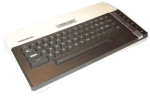 The first Atari 8-bit computers to arrive on the scene in 1979 were codenamed Candy and Colleen, referring to the Atari 400 and 800 respectively. The latter was rumored to be named after an attractive female staff member (she undoubtedly had curly brown hair and lovely chocolate eyes, just like my wife). The Atari 400 was marketed as a gaming system, while its more expensive cousin was seen as a personal computer. The Atari 400 featured a membrance keyboard, which was eventually replaced by a proper keyboard starting with the Atari 800. Much of the “guts” for the 8-bit computer line came from Cyan, the engineering team responsible for the Atari 2600. In a couple of years, they produced three processors for the new computer models: CTIA, POKEY, and ANTIC.
CTIA is an acronyn for Color Television Interface Adapter and was the successor to the TIA chip used in the Atari 2600. It was reponsible for translating the information produced by the ANTIC chip into signals the television could understand. In later machines, Atari replaced the CTIA chip with the GTIA chip which had much more functionality. In addition to the DAC (digital-to-analog converter), the GTIA controls sprites, collision detection, priority control and color-luminance (brightness) to all objects including display lists from the ANTIC processor. Along with all that extra functionality, some GTIA versions made for the European market were buggy due to a PAL processing error.
The ANTIC processor was reponsible for interpreting display lists, which were instructions on how each scan line was to be displayed, line locations, interrupts, scrolling, and indicating where to find resources such as graphics or character sets.
POKEY was responsible for reading the keyboard, generating sound and serial communications. It also provided timers, a random number generator (for sound noise as well as random numbers), and maskable interrupts. POKEY has four semi-independent audio channels, each with its own noise, frequency and volume control. Each 8-bit channel had its own audio control register which selected the noise content and volume. For higher sound resolution, two of the audio channels can be combined for more accurate sound.
The XL versions contained simplified circuitry to help cut down costs and space requirements. The XL versions were also engineered to comply with the new FCC regulations at the time. One particularly interesting feature, called the PBI (Parallel Bus Interface), allowed for unprecedented access to the computer hardware by an outside peripheral. The PBI is a 50-pin port which provides an unbuffered, direct connection to the system bus lines (address, data, control) running at the same speed as the 6502 CPU. Only the 600XL and 800XL computers had such an interface. The XE systems of the day (65 XE, 130 XE, 800 XE, XEGS) came with the Enhanced Cartridge Interface (ECI), instead.
If you don’t have the space or simply do not want the original hardware in your home, there are a few good Atari emulators out there. Atari800Win is an excellent hardware emulator for Microsoft Windows, and is my preferred choice for this platform. Another great emualtor is the open-source project called atari800. Due to the nature of this opensource initiative, it will probably become the leader in Atari 8-bit emulation unless something goes wrong, which is not uncommon for such projects. Obviously the more people who fiddle with the timings and compatibility, the more a project will progress toward the overall goal of 100% compatibility. Whichever version you choose, both have the source code available in case neither supports your favourite platform. One such platform could be the Gamepark handheld device. atari800 was ported to the device some time ago in 2003-2004, but the author has since dropped the project.
If software development is more to your liking, then you may appreciate programs such as CC65. CC65 is a cross-compiler/assembler suite for a variety of destination platforms such as Atari 8-bit and Commodore 64. This cross-compiler will create binary files that are compatible with the desired microprocessor. Compilers are usually complex tools at the best of times, but don’t let that stop you! If you don’t want to program in assembly language, then CC65 will let you write your software using the “C” programming language. “C” is considered a higher level language by many people, but these people obviously haven’t dealt with nested pre-processor macros before. For the more hardcore amoung you, there is always the option of using a native Atari assembler to write your software. You may even be able to use BASIC – don’t underestimate its power! I’ve written several programs using BASIC and the results never fail to impress… myself.


One Response to “Atari 8-bit Computers”
Actually the 800 had a proper hard-key keyboard, only the 400 had the membrane keyboard. As I recall, the 8-bit line started out as the gaming machine that was to supplant the 2600, however once the home computing market exploded, Atari quickly steered the project towards competing in that new market. Which is why the Atari 400 was sold partly as a game machine, with its cartridge slot and four controller ports, but also as a fairly powerful home computer, into which you could plug a disk drive, printer, modem, etc, all the things that made a computer a computer. In 1979 that sort of feature set was nothing short amazing, especially considering the low price of $549 (later approx. $180). Either way, the 400 still stands as a great home gaming console with tons of fantastic arcade ports available. You won’t find the games as easily as you would the 2600 games, but the 8-bit Atari line was leaps and bounds beyond the VCS in terms of sound, graphics, expansion, and you still even got to use the same familiar and awesome 2600 controllers. I’m going to go play Frogger on mine right now. Ciao!
Care to comment?